Originally reported November 8, 2026, at 23:51 UTC+8.
Ethereum co-founder Vitalik Buterin argued that ETH should be viewed primarily as a store of value, rather than valued by how much ETH the network burns in transaction fees. He said Ethereum should retain EIP-1559’s fee burn, but holders “should not feel sad” if it remains below 10% of the level needed to offset new issuance indefinitely.
Why Buterin questions a burn-based valuation
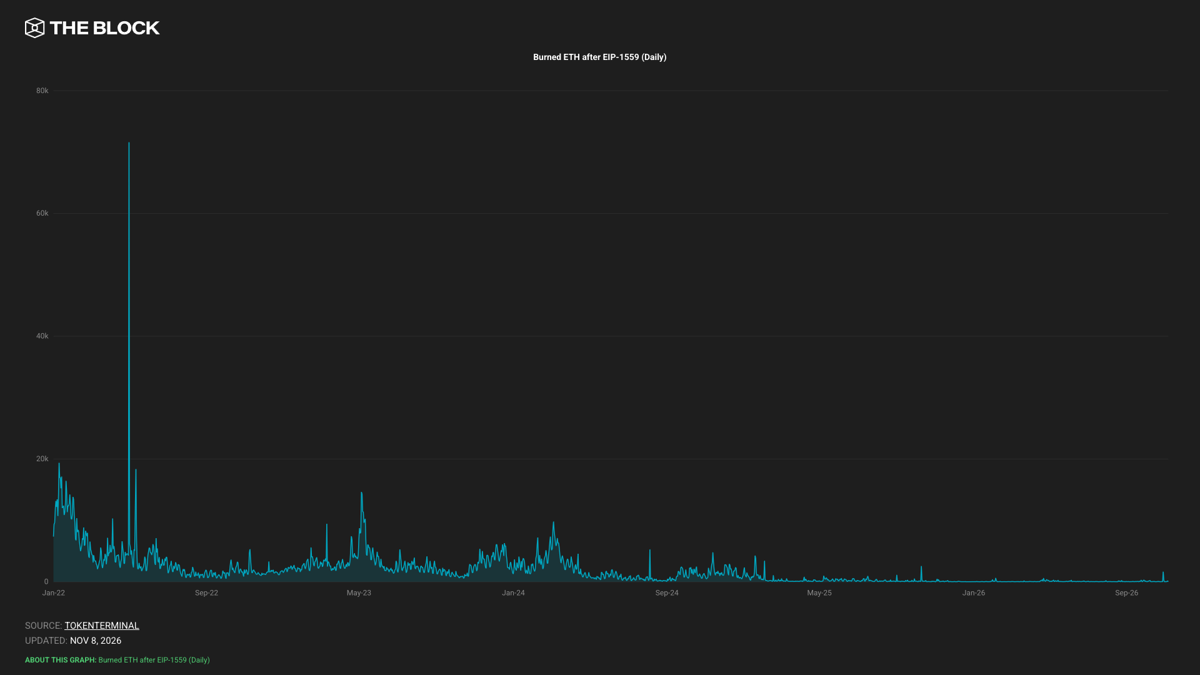
Buterin described a model in which a token’s value equals its annual fee burn divided by a discount rate. His example—$1 billion burned annually at a 4% discount rate—produces a $25 billion valuation. He cautioned that this is not a reliable floor when the activity generating fees can decline alongside the token’s price. He pointed to the fee spike during Yuga Labs’ Otherdeed sale as an example of demand driven by activity within crypto.
The Block’s data illustrates how variable the burn has been: Ethereum burned about 1.48 million ETH in 2022, worth roughly $3.6 billion, compared with about 19,200 ETH, or $43 million, so far in 2026 as of the original report. Buterin said tokenized real-world assets offer a stronger potential source of demand outside crypto, though he did not expect a mature market for them to produce comparable fee spikes.
Buterin also argued that pursuing more burn would require substantial protocol funding and sustained interventionist governance. Using an AI-generated estimate of L’Oréal’s research-and-development spending as a comparison, he calculated that matching its spending rate would require about 700,000 ETH a year in protocol funding and cut validator revenue by two-thirds. He said incentives to raise fee revenue could also mean higher gas prices that exclude users.
His preferred emphasis was on Ethereum’s ability to endure through decentralization, censorship and capture resistance, privacy, and security—not on maximizing fee burn. This was a position on ETH’s value case, not a change to its issuance or fee-burn rules.
The debate followed the withdrawal, about five weeks before the report, of EIP-8363 from consideration for the planned Hegota upgrade. That proposal would have burned a rising share of validator rewards as more ETH was staked; it was not enacted.