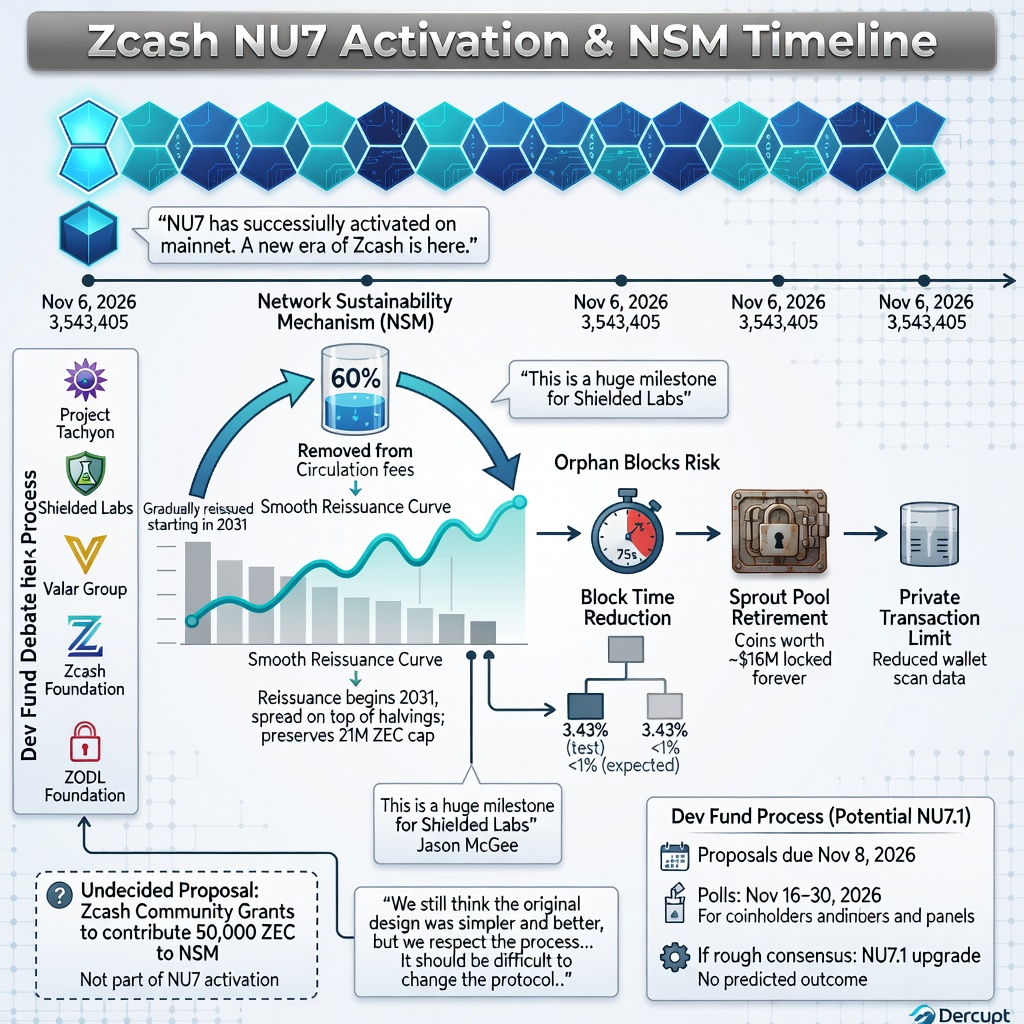
Decrypt reported on November 6, 2026 (18:13, UTC+8) that Zcash’s NU7 network upgrade went live at block 3,543,405 early that Friday. The activation switched on the Network Sustainability Mechanism (NSM), a rule intended to help pay for security as block subsidies shrink. The project’s official account posted: “NU7 has successfully activated on mainnet. A new era of Zcash is here.”
Who is paid, and when supply comes back
Zcash inherited Bitcoin’s open question: after each halving cuts the subsidy, will transaction fees alone be enough to pay miners to secure the network?
Under the NSM, 60% of transaction fees are removed from circulation and gradually reissued as future block rewards. The 21 million ZEC maximum supply cap is unchanged. This is a shift in the timing of issuance, not an expansion of the cap. Reissuance is set to begin in 2031, with the recycled fees spread along a smooth curve on top of the existing halving schedule. The source does not state how large those fees will be, so the 60% split is a share of whatever fees users pay, not a fixed payout.
Jason McGee of Shielded Labs, the organization behind the mechanism, called the activation “a huge milestone for Shielded Labs” in a post before the block. He said the NSM was Shielded Labs’ first project and builds on an idea developer Nate Wilcox proposed years earlier, originally called the Zcash Posterity Fund.
A separate proposal still under consideration would require Zcash Community Grants to contribute 50,000 ZEC from its treasury to the NSM. That contribution was not described as part of the upgrade that activated.
Why the halvings remained
Shielded Labs’ original design would have replaced Zcash’s halvings with a smooth issuance curve. Community panels supported that change; coinholders did not. The design that shipped keeps the halvings and adds the recycled-fee curve on top of them.
McGee wrote: “We still think the original design was simpler and better, but we respect the process that led us here.” He added: “It should be difficult to change the protocol, and the process should resist capture by any single organization, group, or influential individual.”
The reported incentive effect is limited. Miners still face a declining subsidy under the halving schedule. From 2031, a portion of earlier fee revenue is scheduled to reappear as block rewards, which could supplement fees if fee revenue is thin. The design does not set fee levels, miner revenue, or demand for ZEC, and a fixed maximum supply is not a claim about value.
Faster blocks, a retired pool, and a tighter private-transaction limit
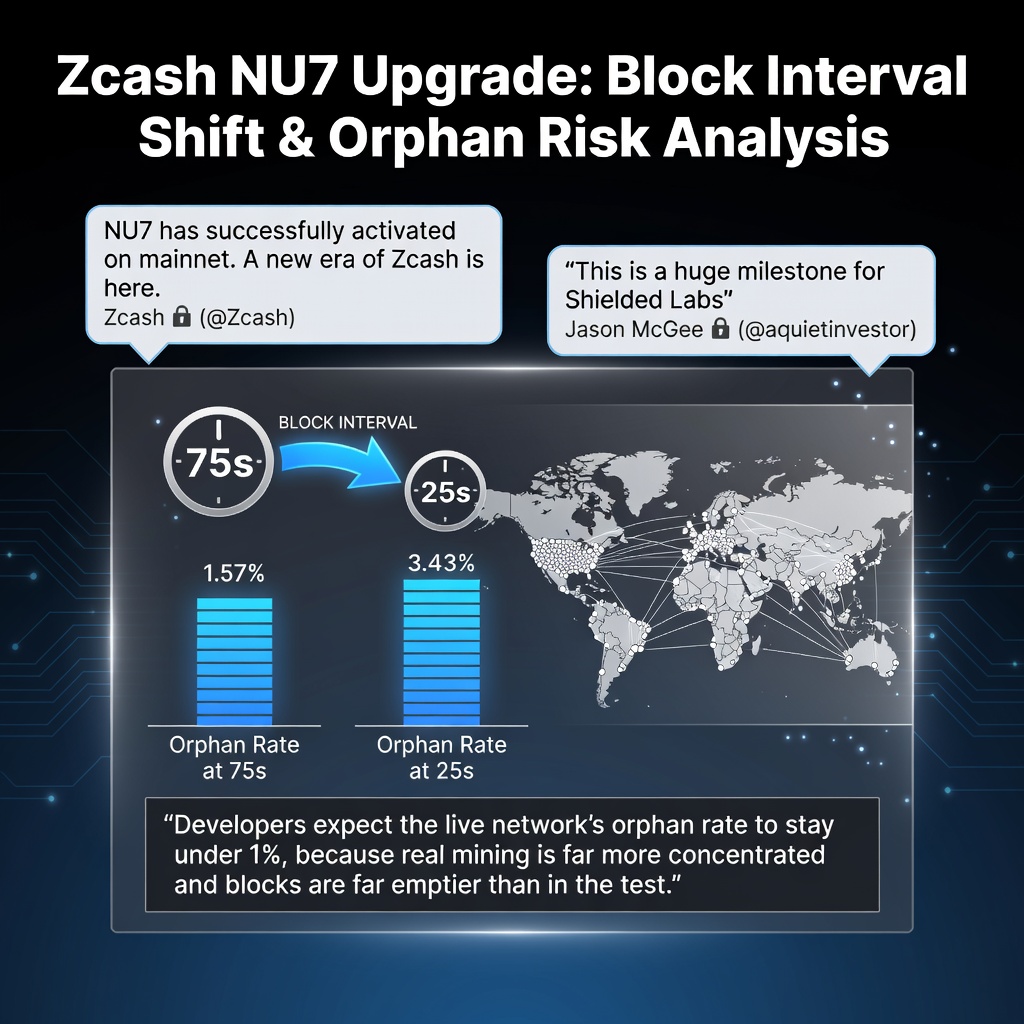
The Zcash Foundation said NU7 cuts the target time between blocks from 75 seconds to 25 seconds. Shorter targets raise the risk of orphan blocks: valid blocks the network discards because another miner’s block reaches the rest of the network first.
In a stress test of 80 nodes across 11 regions, with every block full of private transactions, developers of Zakura measured an orphan rate of 3.43% at 25-second blocks, compared with 1.57% at 75 seconds. The article said Zakura had, the previous month, proposed a quantum privacy fix for shielded swaps. Those developers expect the live network’s orphan rate to stay under 1%, because real mining is far more concentrated and blocks are far emptier than in the test. The two percentages are measurements from that test, not a live-network result.
NU7 also retires Sprout, Zcash’s original privacy pool from 2016, leaving coins worth about $16 million locked in the pool. According to the upgrade specification, NU7 further limits how much private-transaction activity can fit in each block, reducing the data wallets must scan to find their payments.
A separate argument over the Dev Fund
The same report placed the upgrade beside a debate over the future of Zcash Community Grants and its share of the Dev Fund, the slice of block rewards that pays for development. That debate is about who receives part of issuance, distinct from the NSM’s fee-recycling rule.
The five organizations that coordinate Zcash’s coinholder voting — Project Tachyon, Shielded Labs, Valar Group, the Zcash Foundation, and ZODL — set an expedited timetable. They said “tensions were high” and that a drawn-out debate risked “deepening divisions within the Zcash community.”
As stated in the November 6, 2026 report, proposals were due by November 8, with polls for coinholders and community panels scheduled from November 16 to November 30. If rough consensus emerged, the groups said they would support a further network upgrade, NU 7.1, to implement it. The report did not include a poll result.
Original article: Decrypt, November 6, 2026.