Decrypt’s Morning Minute, published November 10, 2026 (source timestamp 21:24 UTC+8), reported that Vitalik Buterin spent Sunday on X telling Ethereum holders to stop valuing ETH chiefly as a fee-burning token and to value it as a store of value. The letter is written by Tyler Warner. It states that the analysis and opinions are his own and do not necessarily reflect those of Decrypt.
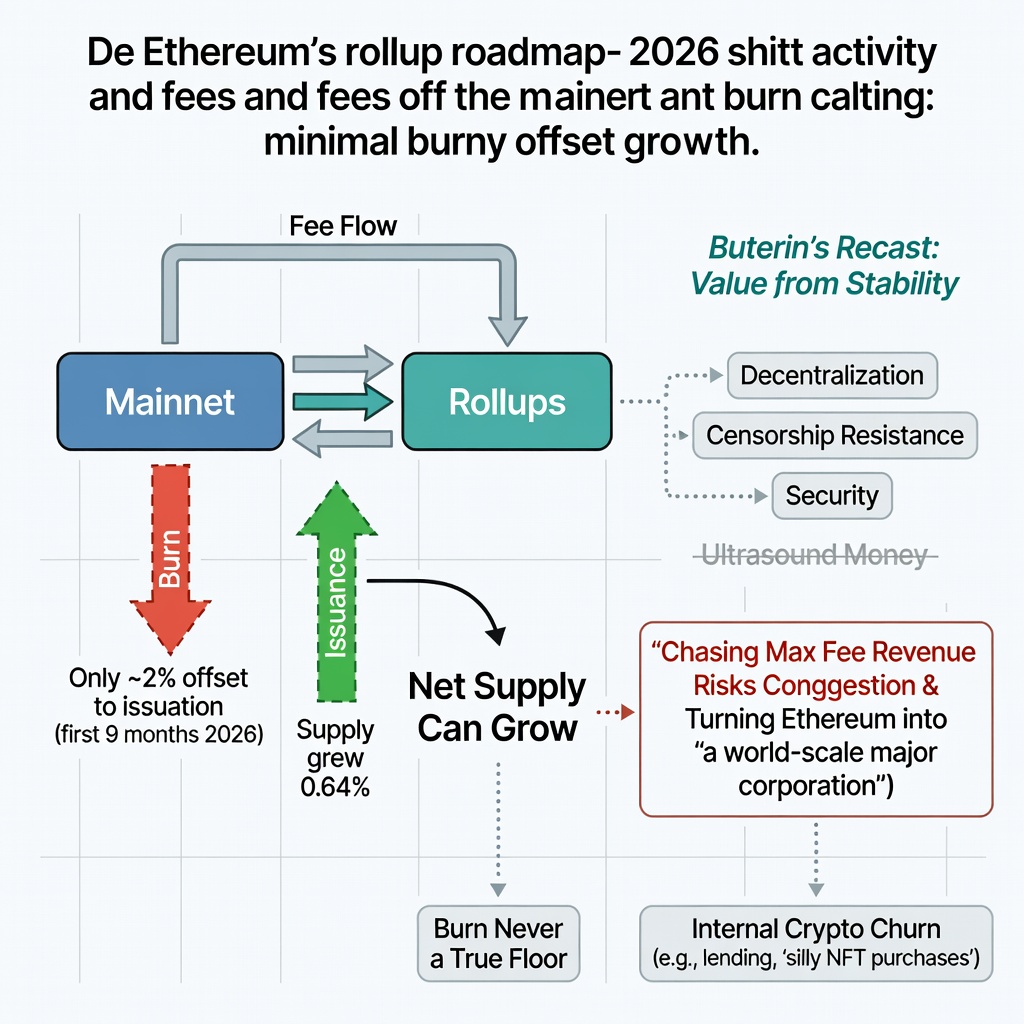
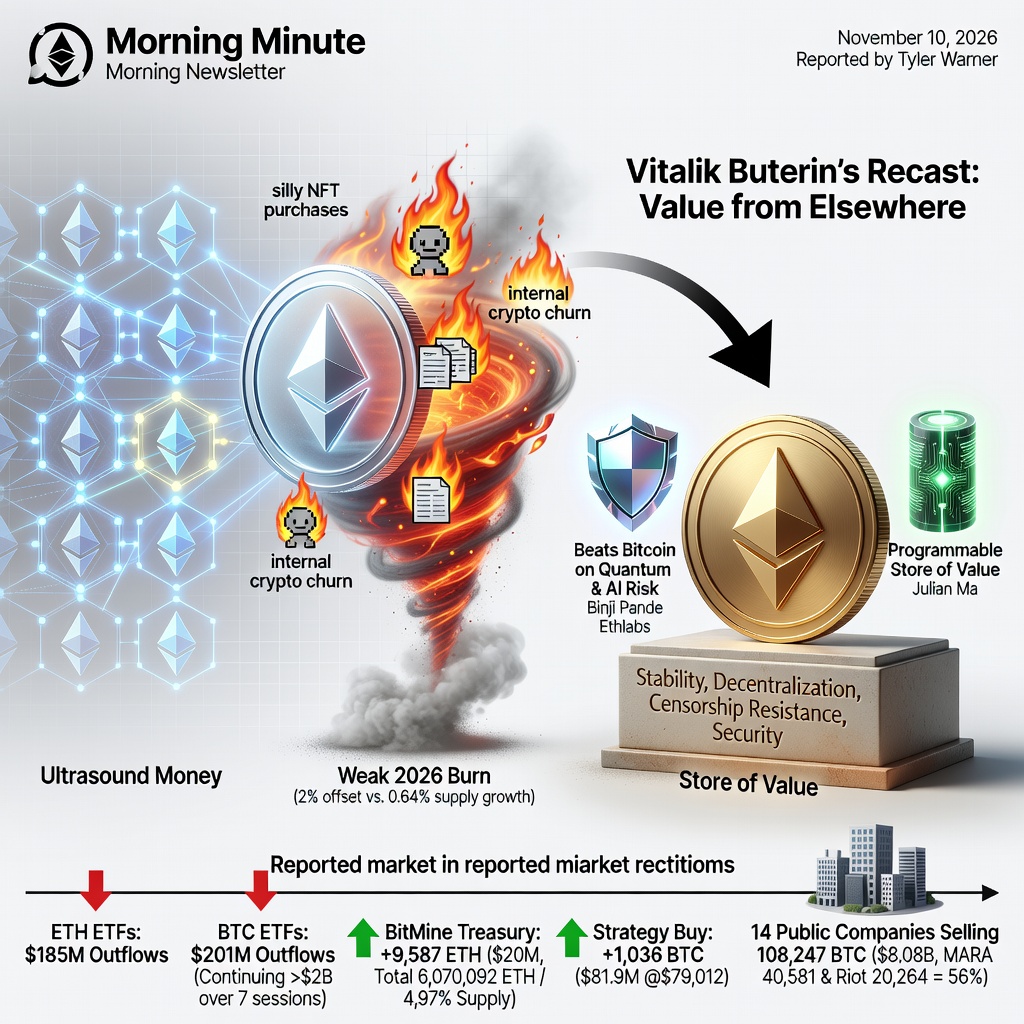
Buterin wrote: “We should not feel sad if fee burn is less than 10% of breakeven indefinitely.” He added: “The value of ETH comes from elsewhere.” Warner reports that “elsewhere” as stability, which Buterin ties to decentralization, censorship resistance, and security. That framing replaces “ultrasound money,” the idea that network usage burns supply faster than staking creates it.
Warner writes that the burn has not kept up for years. Through the first nine months of 2026, burn offset about 2% of issuance while supply grew 0.64%, mostly because Ethereum’s rollup roadmap moved activity and fees off mainnet. On that account, lower mainnet fee flow means less ETH destroyed against ongoing issuance, so supply can still rise. The 0.64% figure is a reported supply change. It is not, by itself, a claim about what ETH is worth.
Buterin’s argument, as Warner relays it, is that this outcome is acceptable and that chasing the burn would be worse. Maximizing fee revenue means wanting congestion and expensive blockspace. Buterin warned that path would turn Ethereum into “a world-scale major corporation” at the cost of what makes it worth using. He also said the burn was “never a true floor” and came mostly from internal crypto churn such as lending and “silly NFT purchases.” Those are activity spikes inside crypto, not the same thing as lasting demand to hold the asset.
Warner notes that supporters were already building the new frame. Ethlabs co-founder Binji Pande calls ETH a future-proof store of value and argues it beats Bitcoin on quantum and AI risk, citing eleven years of trading history and an Ethereum Foundation that holds under 0.2% of supply. Julian Ma of Ethlabs makes a related case that Ethereum’s security culture positions it as a programmable store of value as AI pressures cryptography. Those are attributed arguments, not measured outcomes.
Warner’s objection is that store of value is already Bitcoin’s category. He writes that Bitcoin holds it with a hard cap, more Lindy, deeper ETF plumbing, and a corporate treasury bid ETH is only starting to build, while Zcash is creeping in as a privacy store-of-value pitch. He adds that ETH has not historically been considered a store-of-value play, and that it remains to be seen whether Buterin can cast the pitch successfully.
The same letter records holder and flow facts beside that debate; they do not settle it. BitMine added 9,587 ETH, worth about $20 million, lifting its treasury to 6,070,092 ETH, or 4.97% of supply. Chairman Tom Lee called Buterin’s comments “a seismic shift” that validates BitMine’s strategy — his reading of the remarks. In the prices Warner listed, ETH was -1% at $2,100 and BTC was even at $74,200.
Flows were not one-directional. Warner reported Bitcoin ETF outflows continuing, now more than $2 billion over the past seven sessions. On Monday, Bitcoin ETFs saw $201 million in net outflows and ETH ETFs saw $185 million in outflows. Lookonchain figures in the letter said fourteen public companies had sold roughly 108,247 BTC, worth $8.08 billion, so far in 2026, with MARA at 40,581 coins and Riot at 20,264 accounting for 56% of that total. Strategy bought 1,036 BTC for $81.9 million at an average of $79,012. BlackRock said demand from large holders converting self-custodied bitcoin into IBIT shares was “the highest we’ve seen at any point,” with roughly $3.6 billion of such swaps since the SEC permitted in-kind transactions. These are reported movements of existing coins and fund shares. They are not an unlock schedule, and neither a low foundation balance nor a large single treasury is a guarantee of value.
The incentive contrast in the letter is specific. The older ultrasound-money pitch rewards high usage if that usage burns more ETH than staking issues. Buterin, as reported here, does not want fee revenue maximized when the cost is congestion, and Warner ties the weak 2026 burn to fees leaving mainnet under the rollup roadmap. A store-of-value pitch then has to stand on the properties Buterin named, against Bitcoin’s hard cap and established holding channels and against other assets making their own store-of-value claims. Warner leaves that contest unresolved.
Original article: Morning Minute: Vitalik Recasts ETH as a Store of Value (Decrypt, Tyler Warner, November 10, 2026).