A cryptocurrency market review published on November 24, 2026, described a bounce in several large digital assets, including XRP, Monero and Dogecoin, after a deeper market correction. The same review noted Jensen Huang’s return as Nvidia CEO on November 23, 11 days after his resignation. That announcement was followed by NVDA shares gaining over 30% and the Nasdaq adding around 6.8%, recovering a large share of the prior week’s losses.
XRP network payments
XRP’s reported network use was higher than in October. Average daily payments through November crossed 1.1 million, a 107% increase versus the October baseline. The review tied that rise to the volatility that had accompanied a sharp price breakdown.
The asset recorded more than 1.33 million transactions in the first seven days of November. New accounts over a rolling 24-hour window reached 4,065 wallets, according to an XRPScan query on November 23.
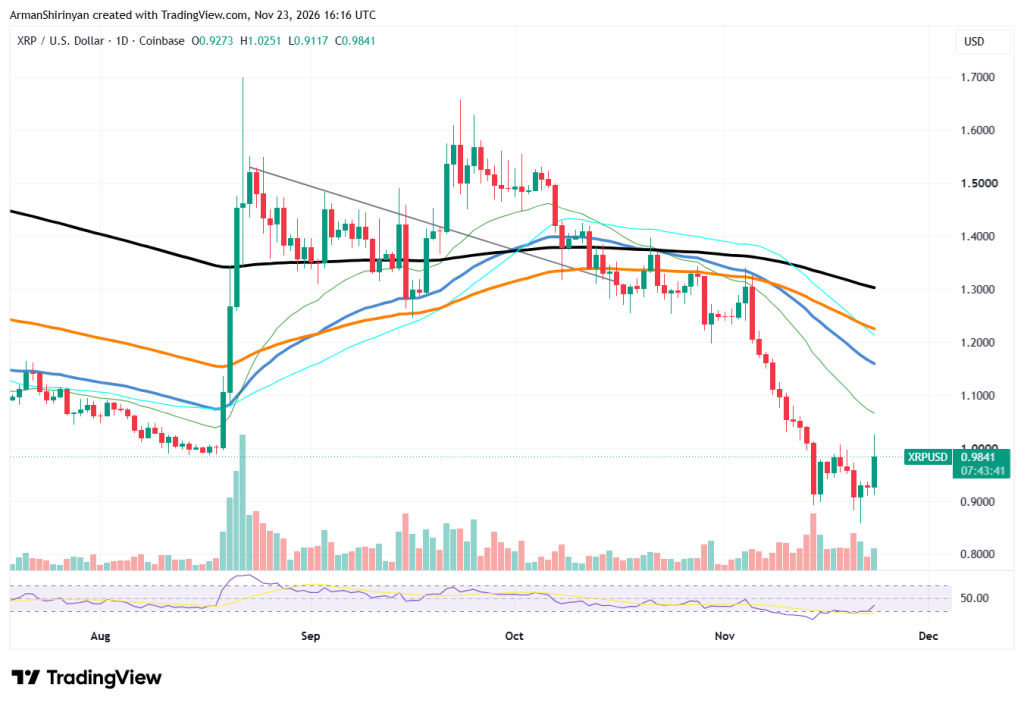
XRP was trading near $0.99, about 23% below its 30-day average. Spot trading volume was down around 22.5% through the month, and futures volume had also declined. After the breakdown, higher volatility had come with a rise in open interest, so the later drop in activity was described as a move back toward the baseline rather than a separate problem.
A local support level was placed at $0.9. The review put an immediate breakout test near $0.99, called $1.00 a psychological barrier, and treated $1.04 as a threshold that would mark the end of the downtrend. Aside from the $0.9 area, those levels were described as not thoroughly tested.
Monero price, open interest and the wrapped-token incident
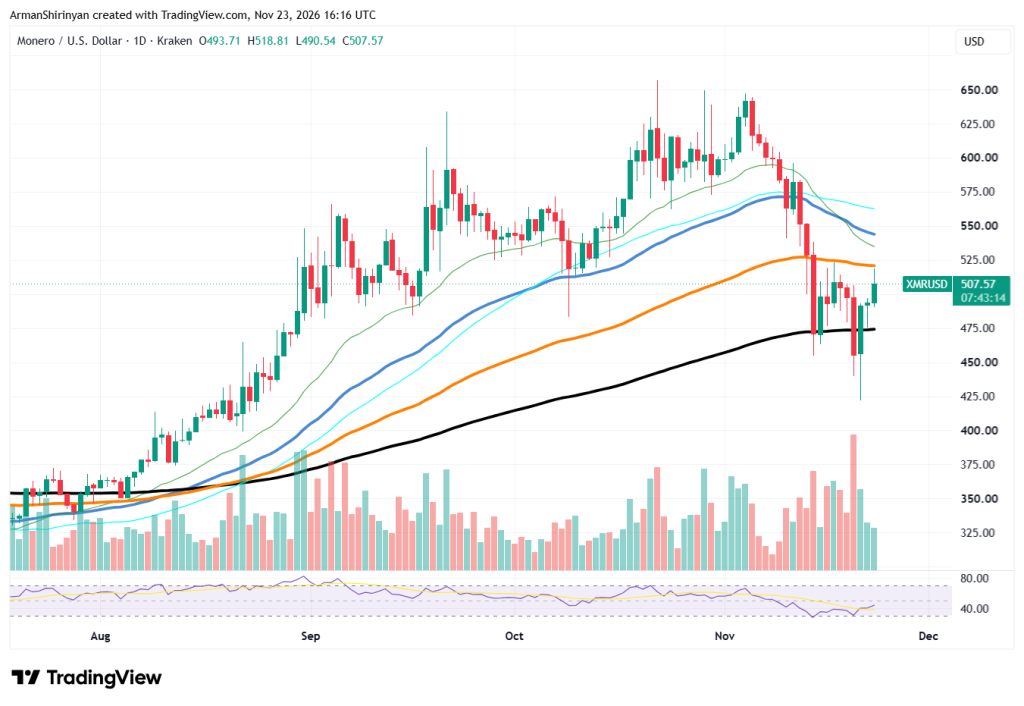
CoinMarketCap data cited in the review showed Monero underperforming XRP and Dogecoin over the prior 24 hours, while Monero’s own price gained over 4.7%. Futures open interest crossed $230 million. On that 4.7% gain, the review called Monero the weaker of the three assets.
Spot and futures volume, open interest and liquidation volume were read as a stale market without strong momentum, not an explosive recovery. Most liquidated volume was on the short side. Transaction count had fallen below the 30-day average. The review noted that Monero’s protected transaction design limits how far on-chain activity can be analyzed.
A separate Wrapped Monero incident was treated as the main nearby development. The wrapped token, which the review said had little connection to Monero’s main network, lost more than 99% of its value and caused $13 million in losses, with selling pressure reaching the coin. Monero’s main network had a security audit on November 18 that found no high- or medium-severity vulnerabilities and only minor issues, which developers were notified about.
The review placed the then-current breakout area around 508–510 and immediate support at $500. Of the three assets, Monero was the only one described as showing some positivity over the prior seven days despite the wrapped-token incident. Privacy assets such as XMR and Zcash were said to often hold up better in breakdowns, most likely because demand for privacy persists.
Dogecoin activity and supply concentration
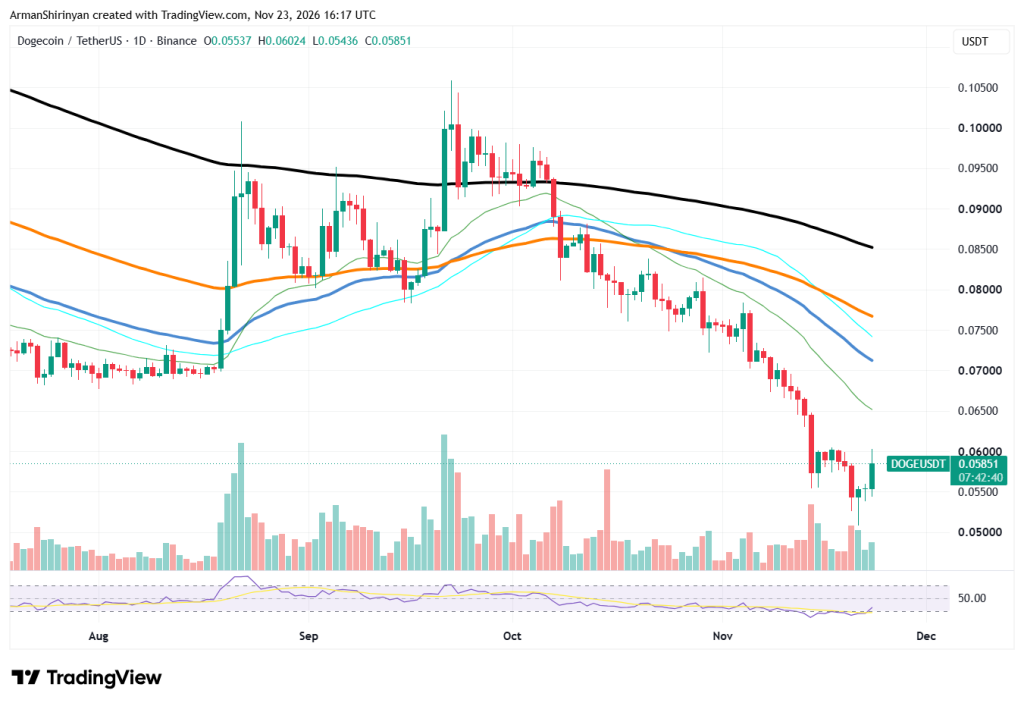
Dogecoin’s recovery attempt was described as stalled. Daily, weekly and four-hour trends were bearish, and price sat below all eight tracked moving averages.
CoinGlass figures showed mixed activity: spot and futures volumes were falling, while open interest rose slightly. Futures volume was $584 million and spot volume was $86 million. Long and short liquidations were balanced.
Network use was thin. Only 37 thousand addresses were active in the prior 24 hours, a 24% decrease year-to-date as of the review. Explorer data indicated that the ten largest DOGE addresses held more than 44% of available supply. The review said this does not mean ten users hold that share; it reflects a high concentration of DOGE on exchanges, a pattern that often adds selling pressure.
With volume and open interest low, the review warned that both resistance and support could be invalidated quickly. It placed first resistance at $0.0599 and a trend-recovery area around $0.06. Support ran down to the psychological level of $0.05, with the nearest level at $0.054. Until price held above $0.06, the review said a recovery case was not well supported.