Pearl’s proposed FP8 hard fork is intended to make its proof-of-work network more compatible with commercial AI inference. As reported on November 19, 2026, the upgrade, known as PIP-3, had activated on testnet, not mainnet. Whether it can turn AI service work into a meaningful source of network security remained unproven.
Pearl’s duplex proof-of-work design aims to let GPU matrix calculations serve both AI customers and the competition to produce blocks. In principle, a provider could earn inference fees while also receiving PEARL block rewards. That incentive depends on mining adding little enough overhead to remain attractive during paid AI work.
Why FP8 matters
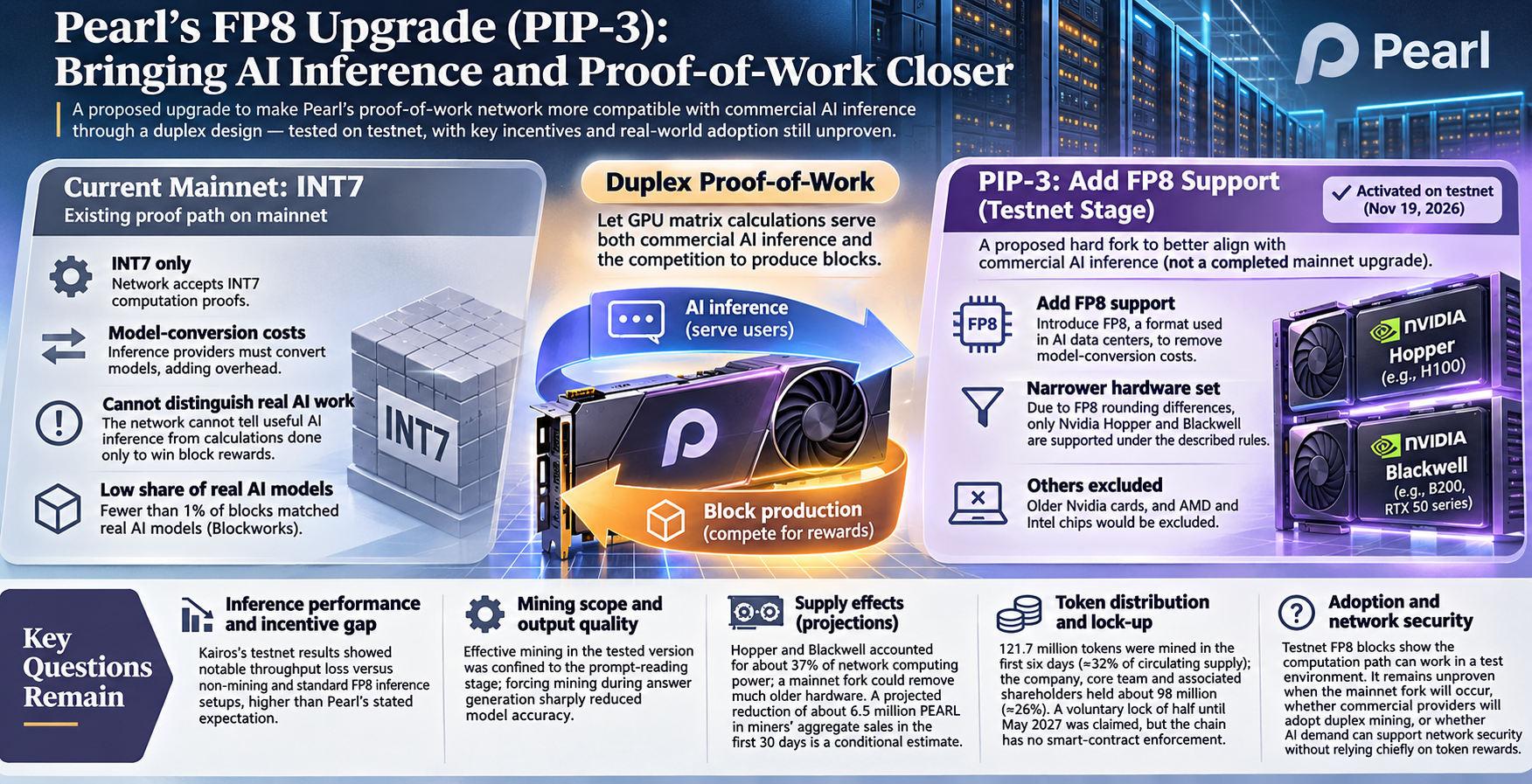
Before the proposed upgrade, Pearl’s mainnet accepted INT7 computation proofs. The article says that requirement imposed model-conversion costs on inference providers, while the network could not distinguish useful AI work from calculations performed solely to win block rewards. Citing Blockworks, it reports that fewer than 1% of blocks matched real AI models.
PIP-3 would add support for FP8, a format used in AI data centers. The change also narrows eligible hardware because differing FP8 rounding behavior can prevent chips from producing identical results. According to the article, the supported Nvidia generations are Hopper and Blackwell; older Nvidia cards and AMD and Intel chips would be excluded under the described rules.
The testnet result—and the remaining incentive gap
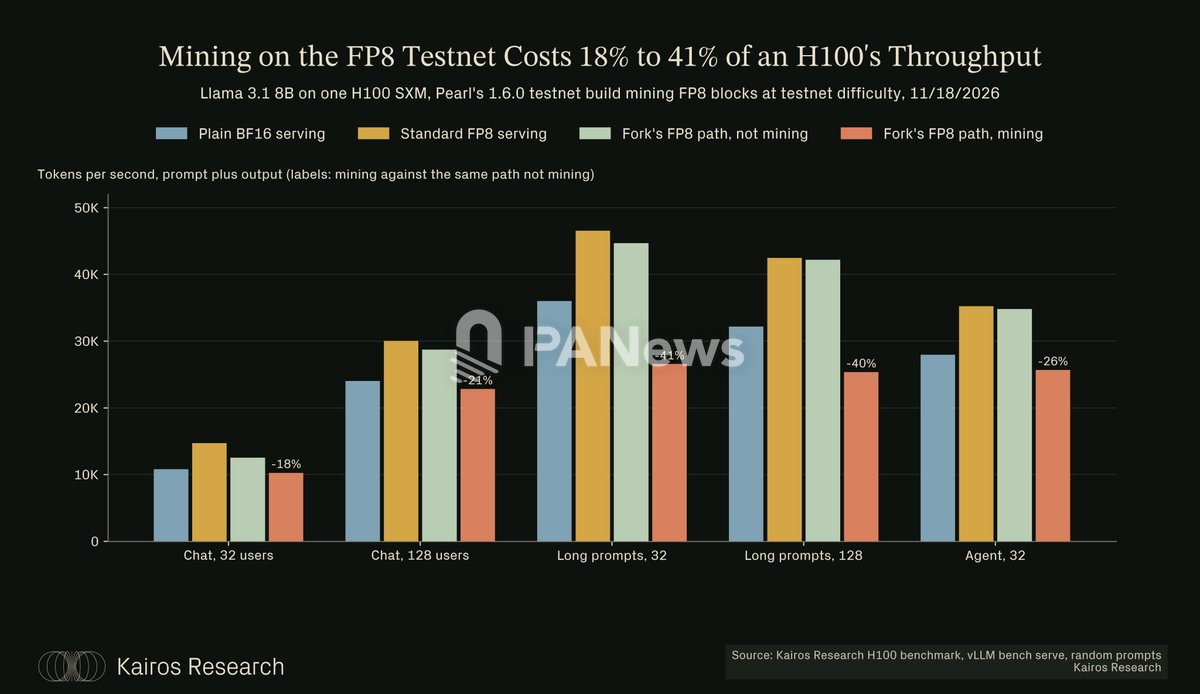
Kairos Research, which held PEARL, tested the upgrade using a rented H100 and Llama 3.1 8B. It produced FP8 blocks while serving the model, but measured an 18%–21% throughput loss in ordinary conversations against its own non-mining setup. The loss reached 26% for agent-style long prompts and 40%–41% for long-prompt-only workloads. Against a standard FP8 inference service, the reported throughput gap was 24%–48%. Those test results differ from Pearl’s stated expectation of a 1%–5% inference-performance cost.
Kairos also found that effective mining was confined to the prompt-reading stage in the tested version. Forcing mining during answer generation reduced accuracy on its math evaluation from roughly 87% to 1%. The article says dedicated mining of otherwise unused calculations could therefore still earn more than providing AI service and mining concurrently.
Supply effects are projections, not an unlock schedule
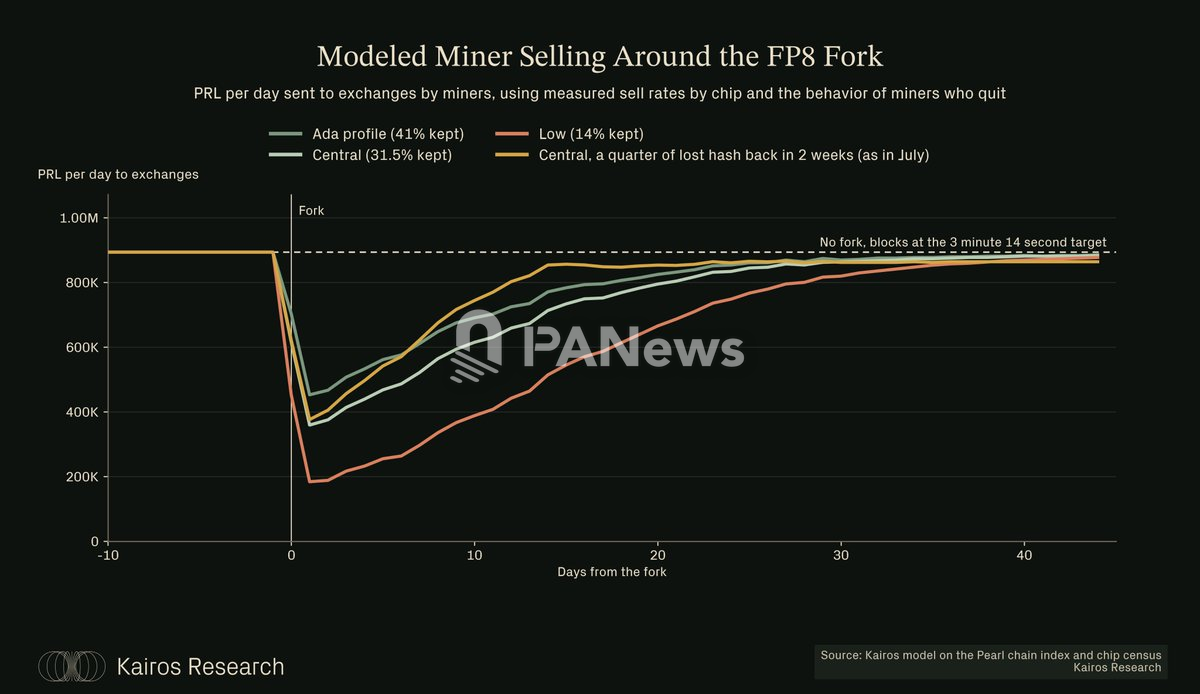
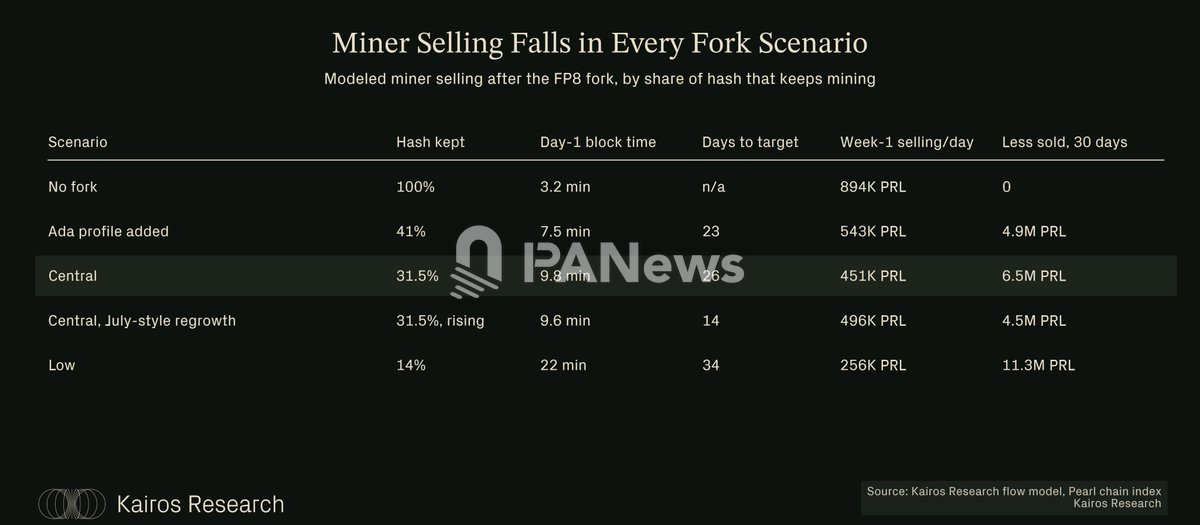
In a survey of six major mining pools and roughly 24,200 addresses, Kairos estimated that Hopper and Blackwell hardware accounted for about 37% of network computing power. A mainnet fork applying the described restrictions could remove much of the older hardware. A possible later inclusion of Ada hardware was discussed as a separate scenario, not an enacted rule.
Kairos’s model projected that slower block production before a difficulty adjustment could reduce miners’ aggregate sales by about 6.5 million PEARL in the first 30 days after a mainnet fork. That is a conditional estimate, not a scheduled token reduction or a guarantee about market prices. The article also reports Kairos’s historical finding that miners transferred 85%–96% of mining income to exchanges or over-the-counter venues; it says departing miners had tended to sell remaining holdings gradually.
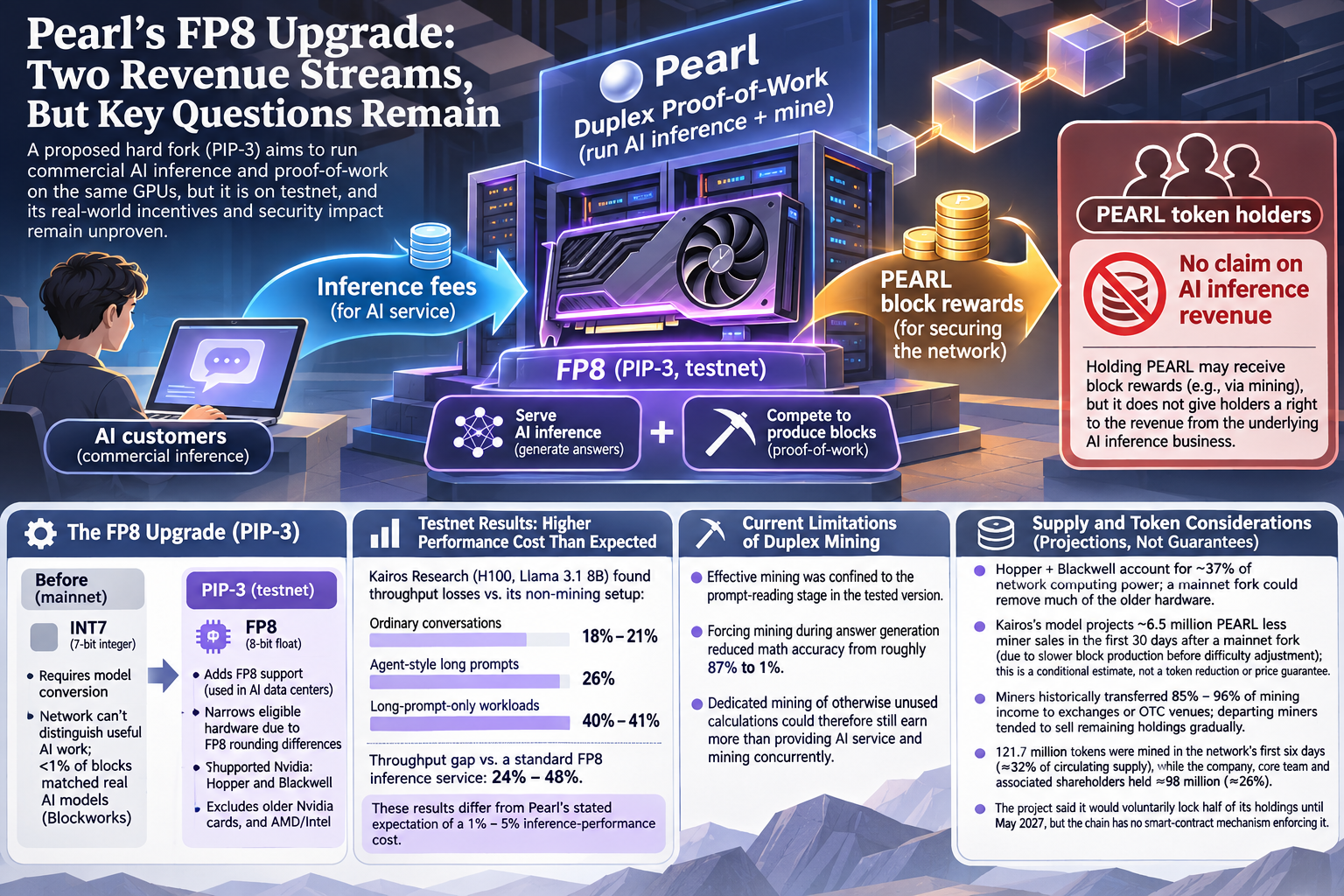
Token distribution presents a separate question. The article reports that 121.7 million tokens were mined in the network’s first six days, approximately 32% of circulating supply at the time, while the company, core team and associated shareholders held about 98 million, or approximately 26% of circulating supply. It says the project claimed it would voluntarily lock half of its holdings until May 2027, but that the chain had no smart-contract mechanism enforcing that lock. The article also notes that token holders had no claim on revenue from the underlying AI inference business.
FP8 testnet blocks establish that the proposed computation path can work in a test environment. They do not establish when the mainnet fork will occur, whether commercial providers will adopt duplex mining, or whether AI demand can support the network’s security incentives without relying chiefly on token rewards.