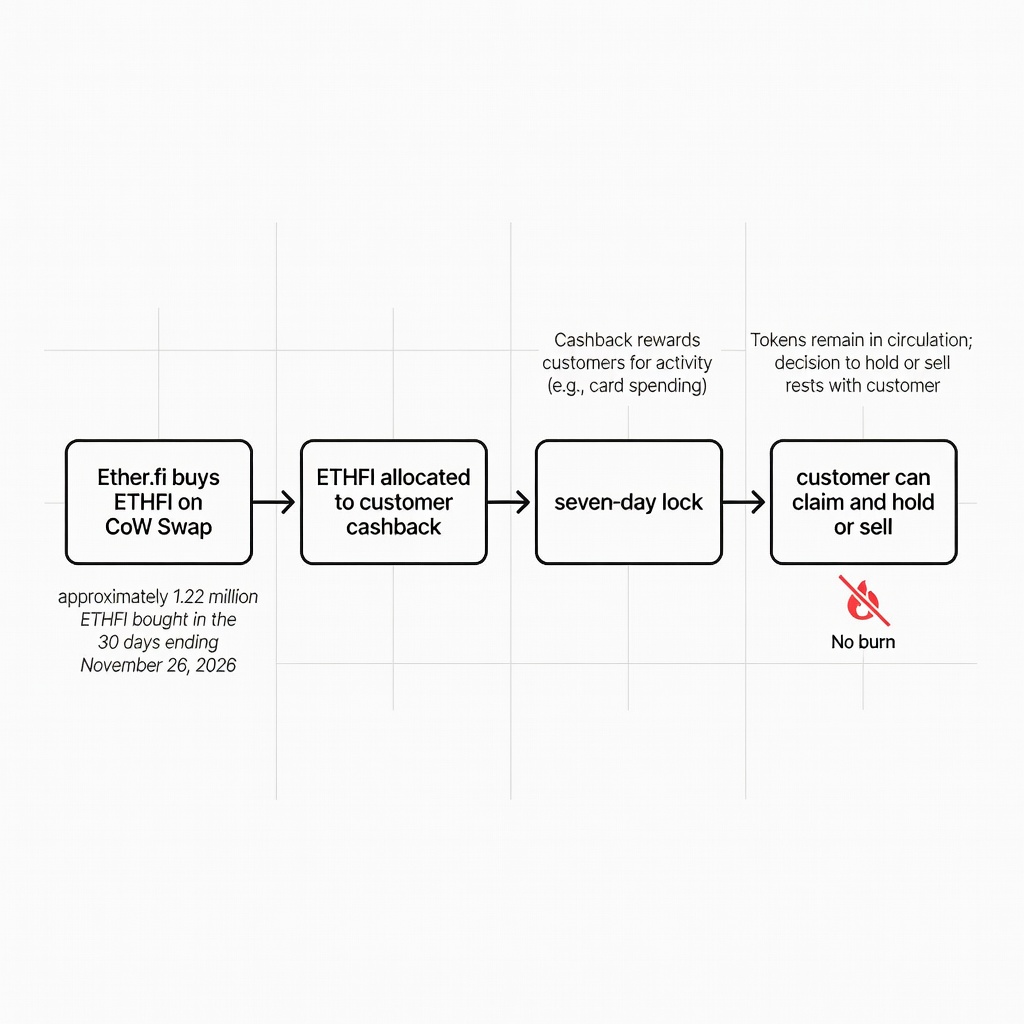
Ether.fi generated $13.44 million in fees and $3.77 million in revenue in the 30 days to November 27, 2026, according to DefiLlama. That put revenue on an annualized pace of nearly $46 million, but DefiLlama attributed none of it to ETHFI holders. The distinction turns on who receives the tokens Ether.fi buys: its cashback program rewards customers for activity such as card spending, not for holding ETHFI.
Where the repurchased ETHFI goes
BlockPinned traced approximately 1.22 million ETHFI in purchases through CoW Swap in the 30 days ending November 26. Under the program, which began in September 2026, customers can claim their ETHFI rewards after a seven-day lock, then keep or sell them. The purchases do not permanently remove tokens from circulation. DefiLlama therefore counts the cost of funding cashback as a business expense rather than revenue for existing token holders.
The foundation had submitted a treasury proposal in October 2025 seeking authority to spend up to $50 million on repurchases under specified market conditions. That figure was a proposed limit, not an amount spent. DefiLlama’s monthly holder-revenue figure fell from $2.95 million in November 2025 to zero in May 2026 and remained there through November.
Card spending grew, but the case for holders is disputed
Ether.fi built its business on Ethereum liquid staking and restaking. Its revenue now also comes from card interchange fees, vault management, borrowing and crypto trading. Alea Research reported in September that monthly Cash card spending rose nearly 85%, from $54.3 million in January 2026 to $100.3 million in July. As staking income weakened, the card’s share of monthly revenue rose from 17% to 46%.
In August 2026, Ether.fi expanded its non-custodial services to include tokenized stocks and metals, portfolio-backed loans and payments in more than 30 currencies. The wider product range had not brought monthly revenue back to earlier levels: DefiLlama recorded $4 million in October 2026, compared with $6.86 million in August 2025, when staking accounted for more of the business.
On November 26, CEO Mike Silagadze criticized how crypto markets value businesses like Ether.fi, arguing that its revenue was “uncorrelated to crypto hype cycles.” ETHFI traded near $0.45 on November 27, down approximately 31.5% over 30 days, according to crypto.news price data.
Commentator TryHardSorry questioned what that operating business was worth to holders of its governance token, arguing that they had no corresponding claim on company profits. Commentator ggmxbt agreed that cashback distributions offset token purchases but argued that attracting customers could be a better use of the money than paying holders directly. ggmxbt disclosed using Ether.fi both personally and professionally through Shift Protocol.
A buyback is not necessarily a burn
Other protocols illustrate why the destination of repurchased tokens matters. Hyperliquid directs eligible trading fees toward HYPE purchases through its Assistance Fund. In August 2026, it introduced a second mechanism that uses revenue from its AQAv2 framework to fund HYPE buybacks.
Sky Protocol allocated $8.72 million to buybacks and staking rewards in the third quarter of 2026: $5.6 million for SKY purchases and $3.12 million for USDS rewards. Its updated framework also uses net revenue to fund permanent burns. Its first burn removed 2.86 million SKY on September 13. Ether.fi’s cashback purchases, by contrast, put ETHFI in customers’ hands and leave the decision to hold or sell with them.