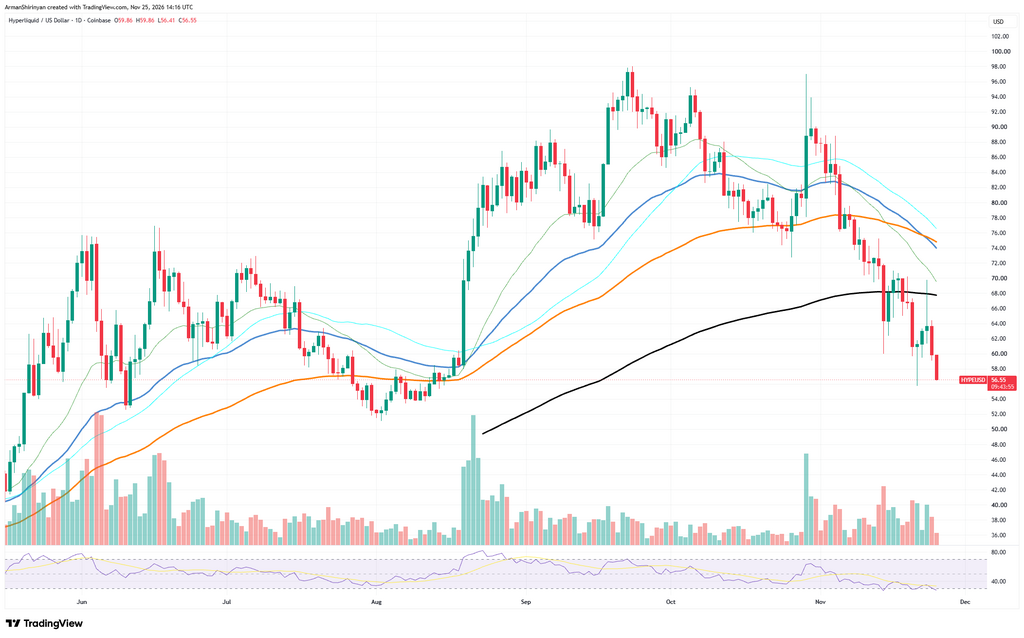
Hyperliquid (HYPE) traded below $60, Zcash (ZEC) hovered near $702.79 and NEAR changed hands around $2.80 in a November 26, 2026 market analysis. All three remained well below their recent highs, but their token economies faced different questions: HYPE buybacks were already under way, Zcash holders were still considering a treasury transfer, and NEAR’s approved issuance cut had yet to begin.
Hyperliquid: $78 million in buybacks did not stop the decline
HYPE had posted a series of lower lows since reaching $98 in September. U.Today’s analysis identified cash flow from platform operations as an advantage for Hyperliquid: activity during volatile markets can generate funds for token buybacks. Even so, $78 million had already gone toward buybacks without arresting the decline.
The analysis identified $60 as the first level HYPE would need to regain. It distinguished a brief rebound on weak volume from the sustained buying pressure needed to break the pattern of lower lows.
Zcash: Treasury vote remains open after NU7 activation
Zcash had recorded the steepest drop of the three tokens, falling from a September high near $1,700 to about $702.79. Its NU7 upgrade went live on November 6, shortening the target block interval from 75 seconds to 25 seconds and introducing other changes aimed at improving private transaction performance.
A separate proposal remained open through November 30. Holders were voting on whether to move 50,000 ZEC out of the Community Grants treasury and redirect future treasury funds toward development and legal costs. Neither change was final at the time of the analysis.
ZEC traded below all its major moving averages. The analysis put immediate support at $690–$700, with $650 and then $600 as possible levels if that range failed. On a rebound, it identified $750–$800 as the first range to reclaim and the former long-term moving average near $870–$880 as further resistance. The relative strength index was approaching oversold territory, but the analysis found no sign of a sustained reversal.
NEAR: Lower issuance ceiling scheduled for February 2027
NEAR’s approved governance proposal, HSP-029, calls for its maximum annual token issuance rate to fall from 2.5% to 1.6% over 24 months, starting in February 2027. The lower ceiling could limit future dilution; it did not reduce the existing token supply or change the issuance limit in force on November 26.
NEAR Intents reportedly passed $40 billion in cumulative transaction volume on November 23. NEAR’s cross-chain infrastructure was reported to support more than 35 blockchains and 100 assets. NEAR had also joined NVIDIA’s Open Secure AI Alliance, though it had not announced implementation details.
NEAR was trading around $2.80, down from its October high near $5.90 and below all its major moving averages. Its relative strength index was nearing oversold territory. The analysis placed immediate support at $2.75–$2.80 and identified $2.60 and $2.40 as potential downside levels, with stronger historical support at $2.40. A recovery would first have to clear $3.00–$3.10; several moving averages converged higher up at $3.40–$3.60.