Pearl’s FP8 upgrade went live on testnet on November 18, 2026, according to a report published the following day. The change is intended to make more AI inference work eligible for PEARL mining rewards. It does not, however, require miners to perform real AI inference.
What changes for miners
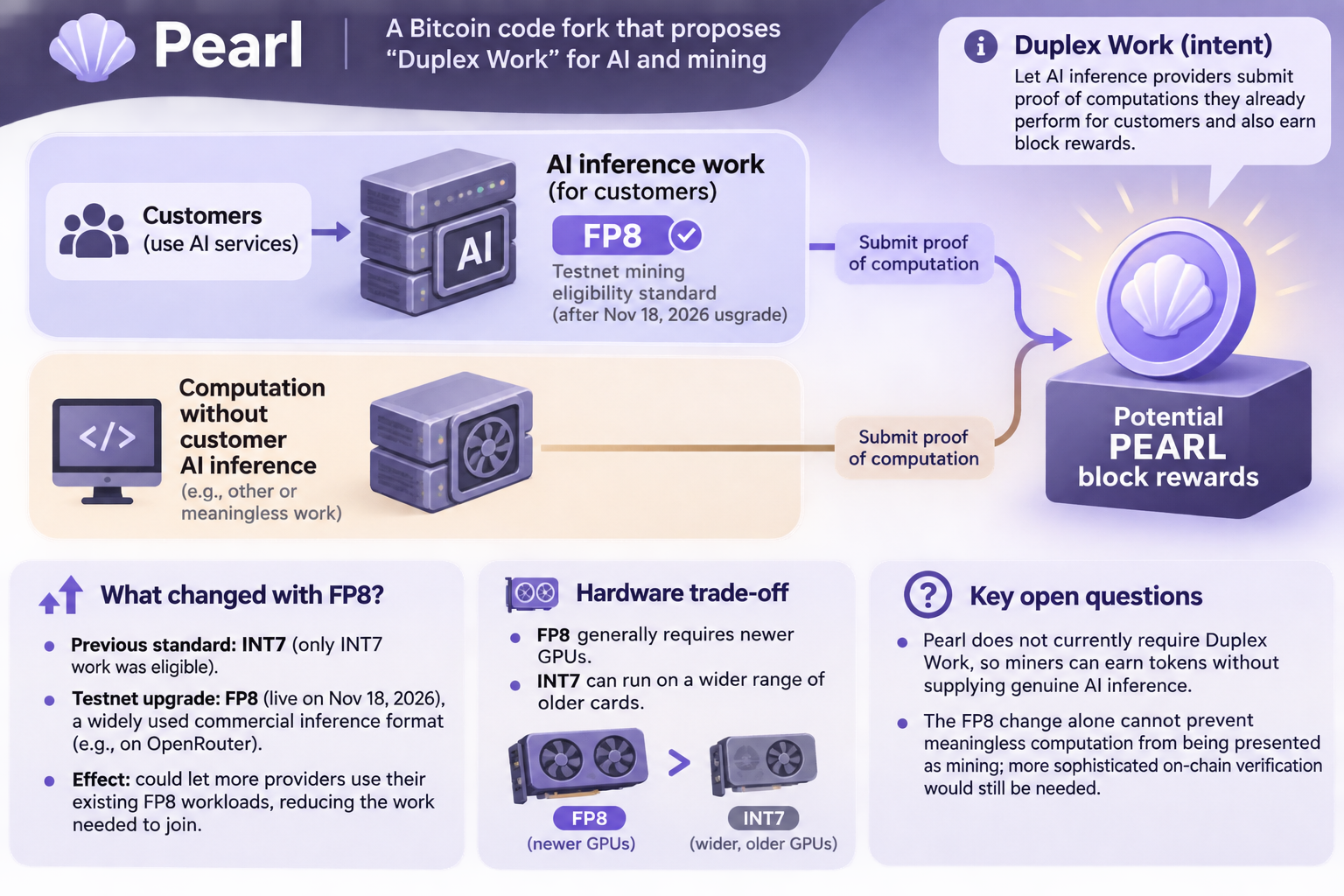
Pearl is a Bitcoin code fork that proposes “Duplex Work”: an AI inference provider could submit proof of computations it already performs for customers and also earn block rewards. Under the previous mechanism, eligible work was limited to INT7, so providers using other formats would have had to convert their models to participate.
The testnet upgrade moves the mining standard to FP8. Bankless analyst David Christopher described FP8 as widely used in commercial inference and said more than 80% of model-inference traffic on OpenRouter runs in that format. If providers can use their existing FP8 workloads, the change could reduce the work needed to join. It also raises a hardware barrier: FP8 computation generally requires newer GPUs, whereas INT7 can run on a wider range of older cards.
The incentive question remains unresolved. Pearl does not currently require Duplex Work, so a miner can earn tokens without supplying genuine AI inference. Christopher noted that the FP8 change alone cannot prevent meaningless computation from being presented as mining; more sophisticated on-chain verification would still be needed.
What would test the economic case
The November 19 report said PEARL had risen over the preceding week amid a weaker broader crypto market, alongside listings on Coinbase and Bybit. It did not establish that the price move reflected demand for AI services.
Potential evidence of adoption would include AI providers publicly confirming that they mine PEARL and pass token-supported savings on through API discounts, less concentrated network computing power, and a measurable share of blocks tied to real customer inference. The last of those is difficult for outsiders to observe.
Crypto researcher hitesh.eth offered a more skeptical interpretation. He argued that Pearl’s appeal depends on Bitcoin miners moving toward AI computing for token incentives, and warned that high token inflation could support short-term speculation without lasting product adoption. He also alleged coordinated influencer promotion around the upgrade. Those are his assessments, not established findings. The report provides no quantified PEARL issuance schedule or evidence that Bitcoin miners have made such a move.