Historical report: Odaily published the underlying account on November 12, 2026, at 16:26 China time. The dates below reflect the plans reported then, not a confirmation that later milestones occurred.
ZetaChain’s community approved its second ZETA-to-Solana governance proposal on November 7, 2026, with 100% of votes in favor, according to Odaily. The plan ties the shutdown of ZetaChain L1 to changes in ZETA’s supply and intended uses.
Migration and validator allocation
Under the approved proposal, ZetaChain L1 was set to stop at block 20,755,000, expected around December 9, 2026. Staking rewards would end at the same snapshot height. Odaily reported that users could claim Solana-based ZETA at a 1:1 ratio through ZetaHub with one signature, no deadline and no fee, including SOL; exchanges would handle conversion of balances they held. ZetaScan and a read-only archival RPC were slated to remain available until October 31, 2027.
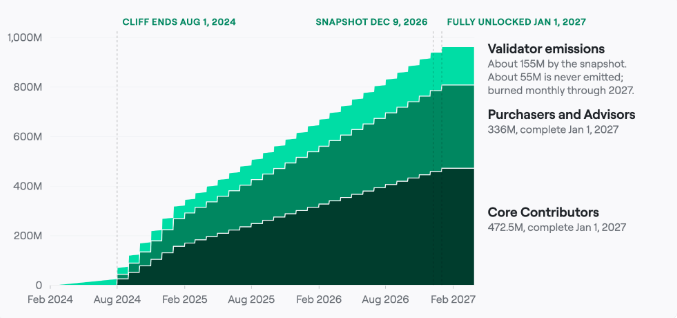
The supply change concerns unissued validator incentives, not a burn of tokens already distributed. Odaily said validators were allocated 210 million ZETA, or 10% of the original 2.1 billion supply. Approximately 155 million were expected to have been issued by the L1 shutdown, leaving about 55 million ZETA. The proposal called for that remainder to enter a Solana burn reserve controlled by the ZetaChain Foundation and be burned in fixed monthly installments during 2027—one-twelfth per month, roughly 4.6 million ZETA. If completed as described, the burns would reduce total supply from 2.1 billion to 2.045 billion by the end of 2027; placing tokens in the reserve would not itself complete those burns.
Unlocks and the foundation’s sales commitment
Odaily reported that the core-contributor and investor allocations under ZetaChain’s 2024 token-generation unlock schedule would be fully unlocked by January 1, 2027. Its article gives their combined allocation as 44.91 million ZETA, but its accompanying allocation chart labels Core Contributors as 472.5 million and Purchasers and Advisors as 336 million—808.5 million combined. Those figures conflict, so the aggregate allocation cannot be resolved from this source. The reported unlock date should not be taken as independent verification of either total.
Odaily also said the foundation committed not to sell ZETA newly unlocked to it during 2027 from the user growth pool, ecosystem growth fund, protocol treasury and liquidity incentives. That is a commitment about specified foundation sales, not a cancellation of the unlocks or a guarantee about circulating supply.
What would create demand for ZETA?
On L1, ZETA served as a gas token. Odaily described a planned shift toward uses in ZetaLabs, ZetaChain’s private AI application on Solana, which was scheduled to launch on December 9, 2026. From the first quarter of 2027, the plan was to let users lock ZETA they retain to access ZetaLabs Premium, spend ZETA on AI credits as an alternative to USDC or bank cards, and vote with ZETA on supported markets, data sources and AI models.
Locking could temporarily reduce available tokens, while spending depends on users choosing ZETA over other payment methods. Neither mechanism establishes sustained demand on its own. Odaily said ZetaLabs had more than 120,000 waitlist users at the time of publication; a waitlist is not evidence that those users would lock or spend ZETA.
Source: odaily.news (originally published 2026-11-12 16:26 UTC+8)